“Next to things of necessity, the rule for a gift, which one of my friends prescribed, is, that we might convey to some person that which properly belonged to his character, and was easily associated with him in thought.”
RALPH WALDO EMERSON, from his essay Gifts
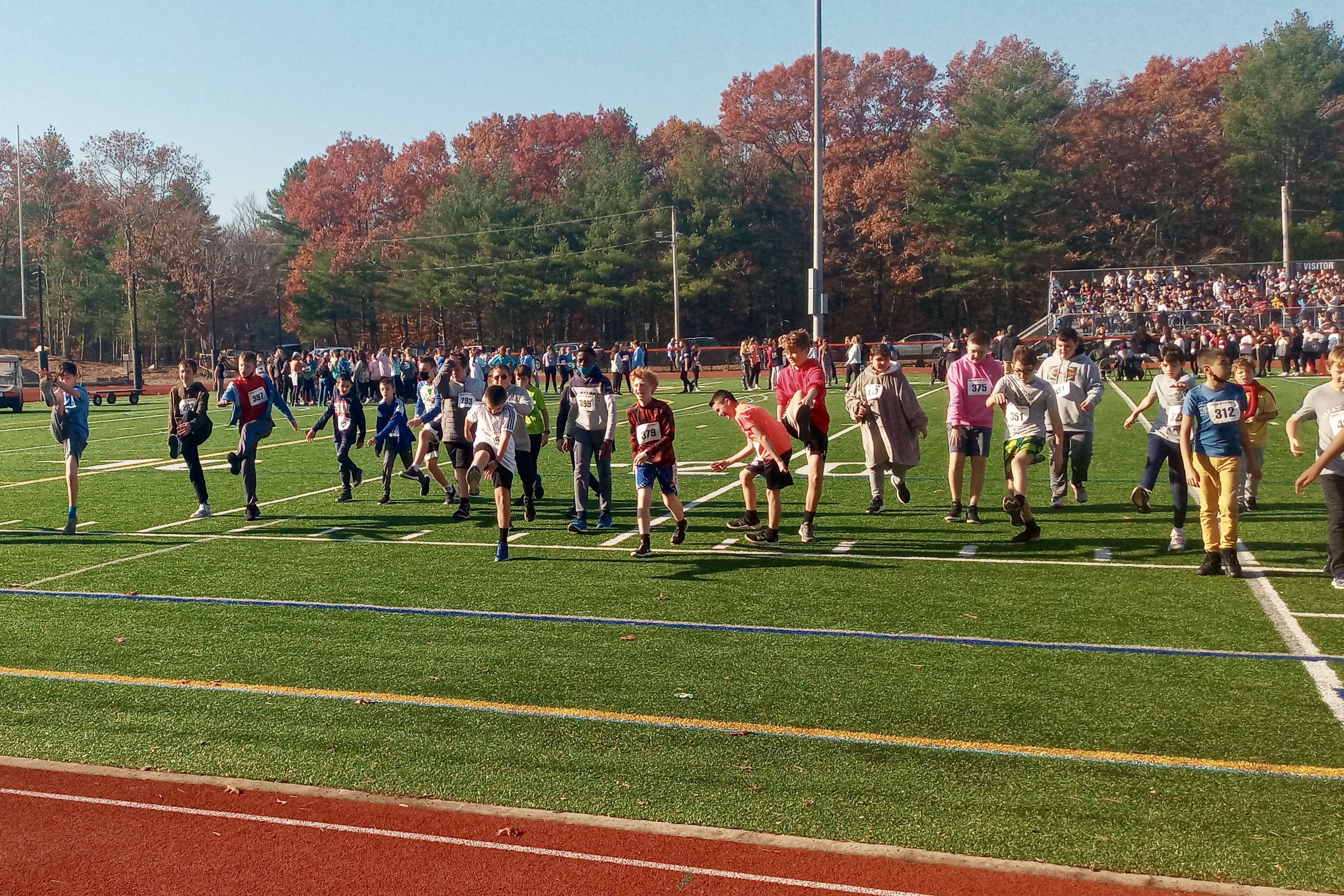
On a Thursday morning last month, the 18th, a week prior to Thanksgiving and commencement of the holiday season. I stood on a field of artificial turf, which is surrounded by a 400-meter tartan track, inside Valentine P. Muscato Stadium at Oliver Ames High School (Easton, MA). The sky was sunny and clear, and the temperature was in the 60s (F).
A few minutes prior to 9, and the place jumped and vibrated with laughter, yelling, screeching, foot stomping, and music. Generating most of the commotion and noise were young adolescent boys and girls — the 6th, 7th, and 8th graders of Easton Middle School — who filled every seat and section of the stands on the “home” side of the complex. The kids, attired in sweats, windbreakers, t-shirts, and athletic footwear were moving with and pulling inspiration from the regionally-renowned Oliver Ames H.S. marching band performing at midfield.
It was the warm-up, if you will, of the Muscato Mile, held every year since the early 1992 — save for 2020 and a period when the pandemic still kept schools in hybrid in-school/remote mode — on the same day as the Great American Smokeout (the third Thursday in November).
The centerpiece of the Muscato Mile are six one-mile “runs” — one each for the boys and girls of the three grades. It’s an out-and-back course over which the students start with a lap around the track, followed by a loop around a field adjacent to the stadium, and then it’s back to the track and the finish.
There are kids who race the mile, and excellence and hard work are rewarded with the first, second, and third-place finishers receiving trophies, and the times and place finishes of these runners, and other top performers, publicly posted. Not everyone is competitive though. Kids comfortably jog the route; others jog and walk; and there are those who only walk. Some teachers amble along with the students. Among those who take a more casual approach to the mile, many do so chatting and gabbing with every step.
But, again, the mile is the locus of the event. On the whole, and all in all, the Muscato Mile is a lot more.
Throughout the morning, rock and rap tunes belt from the PA system. And the youth sing along; they know all the lyrics. They dance in … and out … of rhythm.
If you are not running or walking the mile, you cheer for those who are. Students supportively holler as loudly … maybe more loudy … for those who finish way behind, than they do for those who finish up front.
It is an outdoor activity, and no masks were required, even if maybe a few students wore them. Young people breathed; they exulted.
An immense amount of work, and caring, expended by teachers, primarily in the phys ed department, of the Easton Middle School, along with front-office staff at the school, makes the Muscato Mile happen.
I felt grateful
Valentine P. Muscato Stadium (“Muscato Stadium”) and the Muscato Mile are named for my father, a beloved local legend, an advocate for youth, who taught, coached sports, and served as athletic director at Oliver Ames H.S. for close to 40 years — and also held the position as recreation director for the Town of Easton.. He is a member of a small group elected to three Massachusetts scholastic coaches hall of fames; in my dad’s case those halls are football, basketball, and track & field.
My dad had a tough upbringing. He and his twin sister, Gloria, were born in 1928, in Boston, to unmarried immigrants — Tony, from Sicily, and Bridget, from Galway. Following stays in an orphanage (a relatively positive experience), and unhappy times in foster homes, he and Gloria moved to their aunt and uncle’s farm in Concord,, the home of patriots and poets, revolutionaries and transcendentalists. The twins stayed on the farm for about five years; when they were in their early teens, they went to live with their parents, now married, in a small house in Concord.
My dad considered himself a son of Concord.
(The Muscato family sold most of the farm and adjoining land, a section of which Henry David Thoreau wrote about in his essay, Walking, to the U.S. government, and the parcel is now a National Park Service property.)
Athletics saved my father’s life; so did mentors — primarily his high school coaches, Bernie Megin (football) and Harold “Skip” O’Connor (track), and Father Joseph Sullivan, a Catholic priest who tutored my dad in Latin and nurtured and inspired my father’s faith.
Competing for the Concord High School Minutemen, my dad was a multisport standout.
He scored 12 touchdowns for the 1946 Concord squad that finished 9-0-0, outscoring its opponents 427-12, and commencing a 59-game unbeaten unbeaten streak (there was one tie in that stretch) that is still the Massachusetts high school record; yet it must be noted that the record for most consecutive wins by a Massachusetts football program is 52 games, held by neighboring Acton-Boxborough H.S.
In indoor track as a senior, my dad set a 600-yard mark at the Boston Garden that would not be bested by a high school athlete for 23 years, and finished the season in winning the 440-yard event at the Eastern States Indoor Track & Field Championship at Madison Garden. The following spring, my dad won the Massachusetts state title in the 440. Also that spring, during a day when in Massachusetts a high school athlete could participate in two sports in the same season, in the field he was behind the plate, as a catcher, and at the plate hit for power and high average..
At least 100 colleges and universities recruited my father. He chose the University of Notre Dame, which offered him a full athletic scholarship for track. HIs decision was due in large part to his admiration for Bernie Megin, a Concord High alum who was a reserve quarterback for ND in the mid 1930s, and also my father’s desire to attend a top-tier Catholic school.
Early on at ND, amid a strange and unknown cultural environment, and struggling academically, my father was in over his head. But he stayed after it. And fell in love with the school and learning, and thrived. My dad graduated with honors, in four years, and had a solid running career for the Fighting Irish, and was elected team co-captain his senior year.
(More ties to Concord and its literary history: one day in a class at Notre Dame in which my father was a student, the lesson was focused on, or at least had ties to, Henry David Thoreau and his opus, Walden; or, Life in the Woods. Well, the priest teaching the course said to the class — and, of course, ND was all guys at the time — “Gentlemen, we are fortunate to have among us a native son of Concord. Mr. Muscato, please share with us your reflections on Walden Pond. To which my dad promptly replied: “Father, we used to go parking there; that’s all I can tell you.”)
Following graduation from ND, it was on to two years with Uncle Sam and the U..S. Army, primarily in counterintelligence in Europe. Soon after completion of his military service — in late summer 1953 — Oliver Ames HIgh School hired my dad to teach biology, and serve as the head boys’ basketball coach, and as an assistant coach of both the football and boys’ track and field teams..
My father said his early plans were to get some coaching and teaching experience at OA, and then move on. He got all of the experience but did not move on.
Valentine P. Muscato Stadium was dedicated on Thanksgiving Day 1990, at halftime of the Oliver Ames-Sharon H.S. football game. In his remarks during the dedication ceremony, my father, suffering from renal cancer, enlisted his gift of oratory, signature humor, his sometimes self-deprecating style, and personal history to express his gratitude, and told the crowd that as a high school football player, he competed at Emerson Playground, but he didn’t know what position Emerson played.
The day after Thanksgiving, my father entered the hospital. He would not come home. He died about six weeks later.
Within a year of his passing, teachers and administrators in the Easton Public Schools system founded the Muscato MIle, with the intent that it would be an annual event, a living memorial.
And I return here to that other son of Concord, Ralph Waldo Emerson, and another excerpt from Gifts. Mr. Emerson wrote: “Rings and jewels are not gifts, but apologies for gifts. The only gift is a portion of thyself … This is right and pleasing, for it restores society in so far to its primary basis, when a man’s biography is conveyed in his gift, and every man’s wealth is an index of his merit.”
For just short of four decades, Valentine P. Muscato conveyed his gift, a “portion of thyself,” to youth. That he was here continues to benefit young people..
And every year, on the third Thursday of November, the students and teachers and administrators of Easton Middle School,, in an event, and in a place, named for my dad, convey to his memory, and his legacy, “that which properly belonged to his character” and is “easily associated with him in thought.”
 Public and Media Relations. Executive Writing. Marketing Communications. Public Affairs. Social Media Strategies. Crisis Communications. Ideas.